

8 Often-Overlooked Aspects of Smart Hardware in Whole-Home Customization and Design
Jun 18, 2026
How can whole-home customization projects avoid the costs associated with "delivery mishaps" involving smart electric hardware? From a professional perspective, manufacturing plants at the source outline the structural specifications and installation tolerances for products such as electric lift-and-lower spice racks, vanity tables, and makeup mirrors. By adhering to international certifications and rigorous industrial standards, they help high-end customization projects reduce costs, improve efficiency, and increase premium pricing.

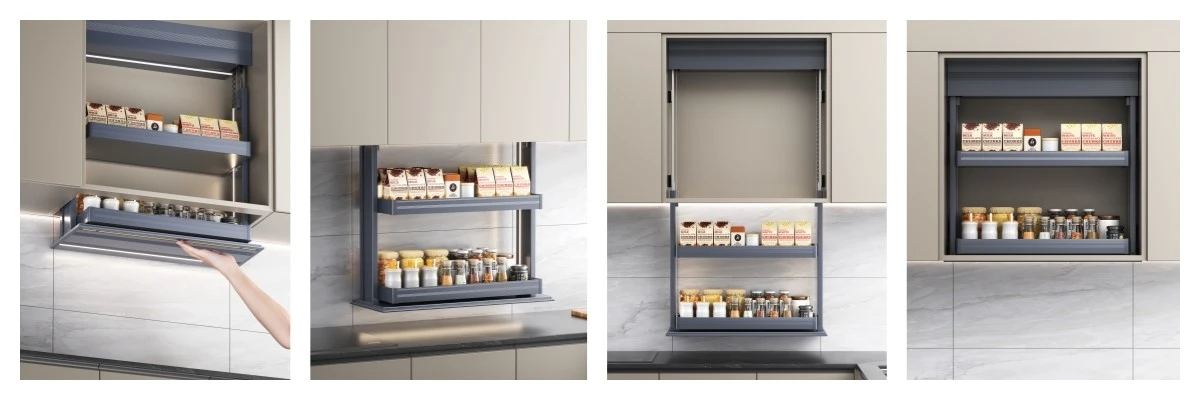
motorized lift down spice rack.

Automatic Lift Cabinet Door

Motorized Smart Vanity Mirror
Amid the current design trends of "modern minimalism" and "hidden kitchens," an increasing number of custom furniture manufacturers and interior designers are incorporating smart motorized lifting hardware into their designs. However, just as people often focus only on the color of roof tiles while neglecting the ventilation system in home construction, many companies prioritize appearance and price when selecting and implementing smart home hardware, overlooking the underlying core technologies that determine long-term delivery quality, safety, and service life. This article will reveal eight of the industry's most overlooked technical insights from the perspective of a professional source manufacturer, helping you reduce after-sales risks and increase the premium on custom projects.
1. Examine the Motor's Core Drive Mechanism and Lifespan
When purchasing electric lift-up pull-out baskets or electric lift-up clothes rods, price comparison should not be your top priority. Instead, you should focus on the "heart" of the electric hardware-specifically, the coordinated lifespan of the mechanical transmission and the motor. High-quality products from source manufacturers must pass rigorous full-load fatigue life tests of over 30,000 cycles. This ensures that the hardware system remains smooth and jam-free even under frequent daily use. Low-end products lacking such rigorous testing are prone to mechanical metal fatigue, transmission misalignment, and motor burnout within six months of delivery, leading to increased after-sales costs.
2. Plan and Reserve Power Outlet Locations Before Design
Many people worry that incorrect cabinet dimensions will render the entire cabinet set unusable, but this concern is largely unfounded-because truly capable hardware manufacturers (such as Angel Particle) possess robust "custom non-standard size" capabilities, allowing them to flexibly adjust the specifications of pull-out baskets, clothes rods, or spice racks based on actual cabinet dimensions. However, two things still require absolute attention: power outlet spacing and concealed wiring holes. On-site wiring after installation not only compromises the feel and aesthetics of high-end custom cabinets but also severely delays the project schedule.
3. The Safety Anti-Collision Mechanism Should "Reverse Direction"
A truly qualified smart mechanical system must be equipped with sensitive, intelligent anti-collision sensors. In kitchen and bedroom settings, safety is an absolute red line that cannot be crossed. When a motorized pull-out basket is lowering or a motorized vanity unit is in operation, traditional screw-type overload protection reacts extremely slowly if small appliances, tableware, or a child's fingers are present below. With a pulley-type system, as soon as resistance is detected, the drive system responds immediately and precisely-stopping the descent and instantly reversing direction to return to the home position. Only this complete reverse retraction mechanism can thoroughly prevent pinching injuries and property damage-unlike some inferior products on the market that merely "pause" due to inertia or move only a short distance.

4. Do Not Overlook Cabinet Load-Bearing Capacity and Back Panel Reinforcement
When fully loaded, smart electric adjustable clothes rods and heavy-duty lift-up baskets exert not only downward gravitational force on the cabinet structure but also shear forces and vibrations during dynamic operation. Many custom cabinet manufacturers simply use traditional 9mm or 18mm standard back panels without any reinforcement, resulting in back panel deformation and loose rivets after a period of use. Standard technical specifications from original manufacturers typically require that the back panel in the installation area be reinforced or supported using specialized, thickened mounting panels to ensure absolute stability under long-term dynamic loads.
5. 24V DC Silent Motors Ensure Long-Term Safety
The choice of motor voltage directly affects electromagnetic radiation, energy consumption, and-most critically-safety risks. High-end electric lift hardware generally uses low-voltage 24V DC silent motors. First, 24V is classified as a safe low voltage, eliminating any risk of electric shock even in humid kitchen environments or in the event of accidental water leakage from spice racks. Second, high-quality DC motors operate at noise levels below 45 decibels, delivering an exceptionally luxurious and quiet experience-a key, subtle detail that enhances the sense of sophistication in high-end custom furniture.
6. International Authoritative Certifications Are the "Passport" for B2B Foreign Trade
For furniture wholesalers, overseas buyers, and export-oriented hardware suppliers, product compliance is the lifeblood of their business. A set of qualified smart electric lifting hardware must possess market access certifications for major global markets, including ISO 9001 Quality Management System Certification, CE Certification, UL Certification, CB Certification, SGS, and ETL Certification. These certifications not only serve as proof for customs inspections but also provide strong evidence that the products meet international industrial-grade standards for electrical safety, environmental sustainability of materials, and fire resistance ratings.
7. Installation Techniques and Tolerance Control Determine Final Service Life
Since smart electric lift hardware consists of precision mechanical components, it has strict tolerance requirements for horizontal and vertical alignment during installation. If the left and right tracks are not parallel or the cabinet itself is tilted, the motor will be subjected to long-term off-center loads during operation, thereby accelerating wear on the drive gears and significantly shortening the service life. Using specialized standard installation alignment templates provided by the manufacturer and adhering to standard specifications during installation to control tolerances to the millimeter level is the key to ensuring smooth product operation.
8. Provision for Whole-Home Smart Ecosystem Integration
The development of smart homes is in full swing. Although most electric lift hardware currently operates via panel switches or remote controls, forward-thinking products incorporate dry contacts, wireless communication module interfaces, or open control protocols into their control board designs. When selecting products, forward-thinking buyers and designers prioritize those that support expansion into a whole-home smart interconnectivity ecosystem. In the future, homeowners will simply need to connect to a smart gateway to control motorized lift-up vanities or motorized makeup mirrors via voice commands or scene modes (such as "Cooking Mode" or "Makeup Removal Mode"), truly bringing their homes to life.


